

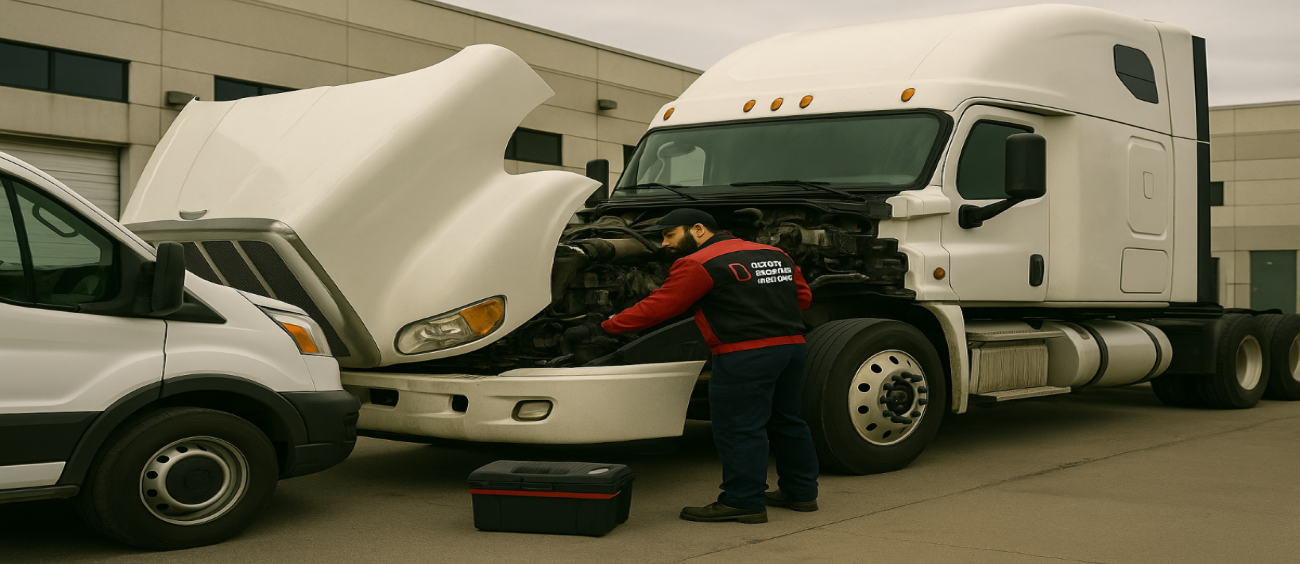
When a commercial vehicle experiences an unexpected highway breakdown, every minute spent on the shoulder costs money, impacts delivery timelines, and creates safety hazards. Whether you are navigating heavy traffic on Highway 40 (Autoroute Métropolitaine), crossing the Turcot Interchange, or driving along Highway 20, reliable on-road truck breakdown services in Montreal are critical to getting your fleet back on the road safely.
This guide details what to expect from 24/7 mobile truck repair, common roadside failures in Greater Montreal, and how fleet managers can minimize costly downtime.
On-road truck breakdown service brings a certified diesel mechanic directly to your stranded vehicle—wherever it is parked, stuck, or broken down.
Unlike traditional garage repairs that require expensive heavy-duty towing, mobile units are equipped with advanced diagnostic software, air compressors, welding units, and an inventory of common replacement parts to perform immediate on-site repairs.
Montreal’s severe winter freezing, extreme temperature shifts, and heavily trafficked highway networks subject heavy vehicles to tough conditions.
| Feature | On-Road Mobile Repair | Heavy-Duty Towing |
|---|---|---|
| Response Time | Typically 30–60 minutes | Requires towing rig allocation |
| Average Cost | Lower (pay for labor & parts) | Higher (hook-up fees + per-km rate) |
| Downtime | Fixed on-site (1 to 3 hours) | Towed to garage + waiting in queue |
| Operational Impact | Driver stays with load & resumes route | Freight transfer or delay required |
Professional breakdown fleets cover all primary corridors in the Greater Montreal Area (GMA), including:
Island of Montreal: Downtown core, Lachine, Saint-Léonard, Anjou, Ville Saint-Laurent, and Montreal-Trudeau International Airport (YUL) corridors.
Highways & Arteries: Autoroute 20, 40 (Métropolitaine), 15 (Décarie), 13, and 25.
Off-Island Regions: North Shore (Laval, Saint-Eustache) and South Shore (Longueuil, Brossard, Boucherville).
When a breakdown occurs, follow these critical safety steps:
Pull Over Safely: Move to the right shoulder or nearest emergency lane, away from moving traffic lanes.
Increase Visibility: Turn on hazard lights, set out reflective triangles or flares at proper distances behind the trailer.
Identify Your Exact Location: Note highway mile markers, nearby exits, or bridge names.
Call Emergency Dispatch: Provide your exact location, truck/trailer type, cargo status, and a description of the symptoms (e.g., brake lockup, smoke, loss of air pressure).